
Torticollis Treatment with Craniosacral Therapy in New York City
Torticollis is a condition with cranial, spinal, and muscular involvement. Soft, non-invasive craniosacral therapy aims to release the shortened neck muscle, support cranial balance, and help restore comfortable head movement and symmetry.
Dr. Alex Kaminsky, D.C., Certified Craniosacral Therapist · treating patients for over 25 years
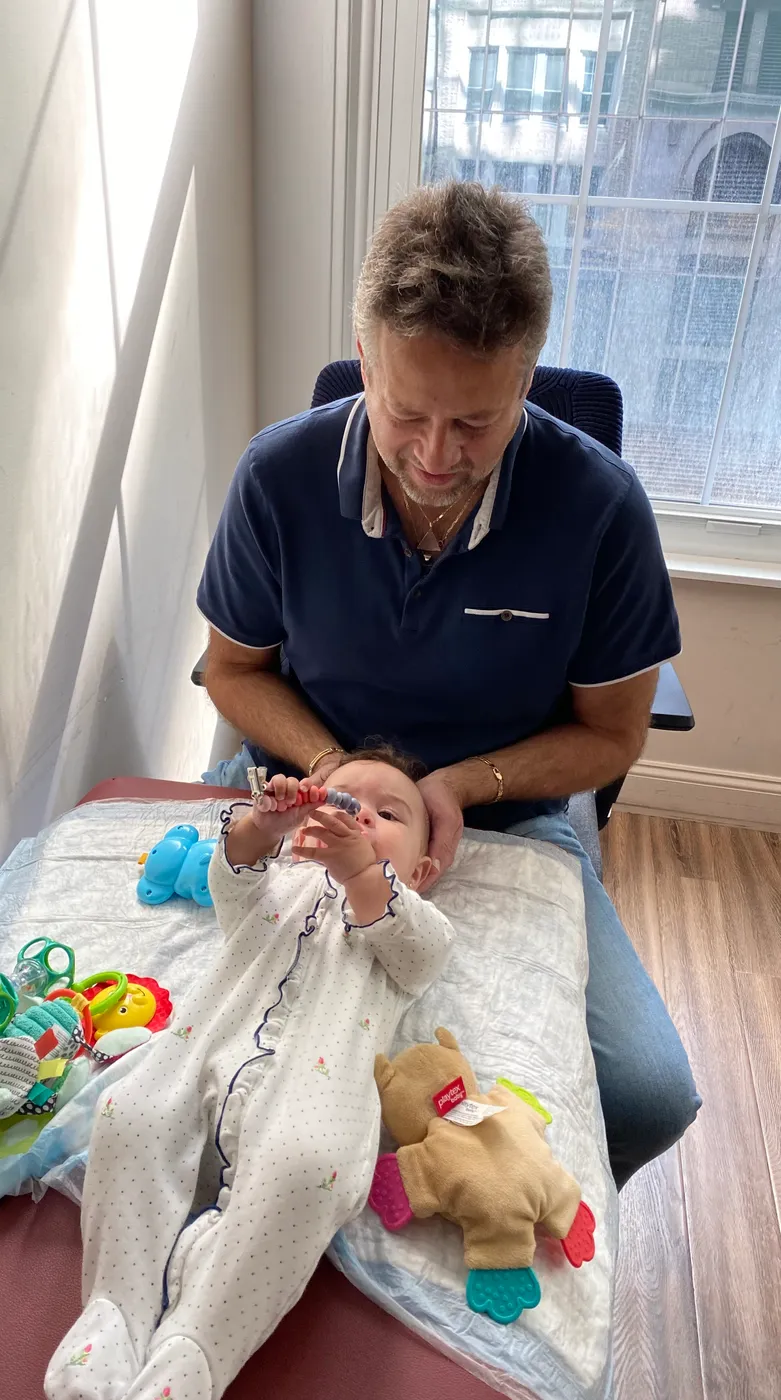
No cracking and no forceful moves — just light, hands-on techniques tailored to your child, offered as a complement to your pediatrician's care.
What is torticollis?
Torticollis is a condition with a cranial, spinal, and muscular component. At its center is the sternocleidomastoid (SCM) muscle of the neck, which is held in a shortened state. That holding pattern is reflexive: the muscle stays short as a result of the cranial bone called the temporal bone being out of alignment.
The neck itself is almost always involved as well. The C1 and/or C2 vertebrae of the cervical spine become rotated out of alignment, which further drives the misalignment of the temporal bone and further shortens and tightens other muscles of the neck. The result is a self-reinforcing pattern: the cranial misalignment tightens the muscle, and the rotated vertebrae and tight muscles hold the cranial misalignment in place.
The cranial component comes first
The primary and most significant issue in torticollis is the cranial misalignment, which often also includes plagiocephaly (flat head syndrome). Because the temporal bone, the SCM muscle, and the upper cervical spine are so closely linked, gentle care for torticollis focuses on releasing these restrictions and helping the area return to balance rather than working on any single muscle in isolation.
Where the muscle and the cranium meet
- The SCM muscle is in a holding pattern — reflexively short because the temporal bone is out of alignment.
- The C1 and/or C2 vertebrae rotate out of alignment, deepening the cranial imbalance.
- As more neck muscles tighten, the misalignment becomes harder to release on its own.
- Plagiocephaly (flat head syndrome) frequently accompanies the cranial component.
Always have your child evaluated by a pediatrician. Craniosacral therapy is a gentle, non-invasive, complementary approach — it does not replace medical diagnosis or treatment, and results vary from child to child. If your child has limited neck movement, a neck mass, fever, or any other warning sign, seek medical attention so other conditions can be ruled out.
Common signs of torticollis
Although the signs and symptoms of torticollis can vary, many infants and young children display a similar picture. These are the most common signs parents notice:
- Inability to latch on for feeding
- Painful breastfeeding for mom
- Flat head on one side (plagiocephaly)
- Constantly leaning the head in only one direction
- Awkward chin position pointing sideways
- Neck muscle stiffness, with the neck looking longer on one side
- Muscle swelling in the neck, which may be present after birth
Look for head and facial asymmetry
The tell-tale signs to look for are head and facial asymmetry. Gently compare one side of your baby's head and face to the other and ask yourself the following questions:
- Is one ear sticking out more than the other?
- Is the ear on one side higher than the other?
- Is the forehead uneven?
- Is one eye lower than the other, or does one eye look smaller?
- Does the mouth look symmetrical?
- Does one side of the head look flatter than the other?
- Does the baby's head or face look uneven overall?
- Is feeding time a difficult task, with trouble latching on?
If the answer is yes to any of these questions, your child may have torticollis, and an evaluation can help guide next steps.
Torticollis in infants: birth and the cranium
During the birthing process, the parietal bones fold over the frontal and occipital bones and between the temporal bones temporarily during vaginal delivery and passage into the world. This molding is a normal part of birth.
However, during delivery the baby's head may not fully inflate, or may inflate unevenly, leaving the newborn with an undetected misaligned cranium or plagiocephaly. Left unaddressed, an imperfect expression of health such as torticollis then often becomes evident immediately or later in life.
Undiagnosed cranial involvement
In torticollis, the temporal bone on the shorter-neck side is usually always involved. It is rotated out of its proper alignment, which causes the shortening of some neck muscles — specifically the sternocleidomastoid (SCM) muscle. This cranial involvement is often the part that goes undiagnosed, even when the tight neck and head turn are obvious. Gentle craniosacral work aims to support cranial balance so the muscle is no longer reflexively held short.
When torticollis appears later in childhood
If torticollis has never been evident before, there is a chance it is a recently developed symptom rather than something present from birth.
Young people also store unprocessed, unresolved emotion, negative experiences, and physical or mental trauma. These incidents can affect the nervous and energetic system of the body, creating holding patterns that tighten specific groups of muscles and lead to the presentation of torticollis. In other words, the same kind of muscular and cranial holding seen in infants can be driven by accumulated stress and strain in an older child or teenager.
Gentle craniosacral therapy aims to help ease the tension that the nervous system is holding, so that tight neck and shoulder muscles can soften. Releasing restrictions in the cranial system can help restore balance and reduce the compensations that otherwise build up over time.
"Releasing restrictions in the cranial system can help restore balance and reduce compensations."
How craniosacral therapy supports torticollis
Gentle, effective craniosacral therapy can help release muscles that are in a shortened state. As fluid moves into the area, the SCM muscle can relax. As a reflex, the neck relaxes, and the spine relaxes — and torticollis improves.
Because the temporal bone, the SCM muscle, and the upper cervical spine are all part of one pattern, sessions address the whole picture rather than a single tight muscle. The work is light-touch and non-invasive — no cracking and no forceful movements — and it focuses on:
- Light-touch craniosacral therapy to release tissue restrictions in the neck.
- Gentle support for cranial-bone, neck, and spine alignment, including the temporal bone.
- Encouraging freer movement of fluid so the SCM can relax and the neck and spine follow.
- Home-care guidance to reinforce in-office progress between visits.
Results you can work toward
With appropriate and skilled hands-on treatments, and recommendations for home care, complete torticollis reversal is possible and attainable. Craniosacral therapy treatment for torticollis with Dr. Kaminsky can help reverse torticollis when approached correctly with exact in-office sessions. Common goals families work toward include:
- Improved head mobility and better symmetry.
- Easier feeding and reduced discomfort during latching.
- Less muscular tightness and healthier posture and movement habits.
Parental home-care activities shown in the office by Dr. Kaminsky add therapeutic value and can decrease the number of in-office visits needed. The practice often combines craniosacral therapy with related gentle methods such as myofascial release when appropriate, and many torticollis cases overlap with plagiocephaly (flat head syndrome).
This information is educational and does not replace medical advice. Craniosacral therapy is a gentle, complementary approach; outcomes vary from child to child, and care is offered alongside — never instead of — your pediatrician's diagnosis and treatment.
Why feeding can be a struggle
Feeding time can be a real challenge for the mother. Either the baby cannot effectively latch on to the breast, or bottle feeding seems labored — and these are further indicators of cranial misalignment and, in turn, torticollis.
During feeding, if the baby is successful in latching on to the nipple, it is often painful for the mother. Feeding can then become emotionally and physically draining, which can discourage this natural process at exactly the time when a baby needs to feed well. When head turning is limited to one side, finding a comfortable feeding position becomes harder for both baby and parent.
Easing the underlying neck and cranial restrictions is part of why gentle care can make feeding more comfortable. If feeding difficulties are a concern, you may also find our pages on tongue-tie and reflux helpful, as these can affect feeding comfort as well.
Torticollis and craniosacral therapy: FAQ
What is torticollis?
Torticollis is a condition with cranial, spinal, and muscular involvement. The sternocleidomastoid (SCM) muscle is held in a shortened state, reflexively tight because the temporal bone of the cranium is out of alignment. The neck is almost always involved as well, with the C1 or C2 vertebrae rotated out of alignment. The most significant issue is the cranial misalignment, which often also includes plagiocephaly (flat head syndrome).
What are the signs of torticollis in a baby?
Common signs include the head constantly leaning in one direction, an awkward chin position pointing sideways, neck muscle stiffness, a flat spot on one side of the head, and facial asymmetry. Feeding can also be a struggle, with difficulty latching on and painful breastfeeding for the mother. If you notice several of these signs, an evaluation can help guide next steps.
Can craniosacral therapy help with torticollis?
Gentle, effective craniosacral therapy can help release muscles that are in a shortened state. As fluid moves into the area, the SCM muscle can relax, and the neck and spine relax as a reflex. With appropriate, skilled hands-on treatment and home-care recommendations, complete torticollis reversal is possible and attainable. Results vary from child to child, and craniosacral therapy is a complement to, not a replacement for, your pediatrician's care.
Why does feeding become difficult with torticollis?
Feeding can be a challenge because of the underlying cranial misalignment. The baby may be unable to latch on effectively, or bottle feeding may seem labored. When the baby does latch, it can be painful for the mother and often becomes emotionally and physically draining, which can discourage this natural process. Difficulty with feeding is a further indicator of cranial misalignment and torticollis.
Should I wait to seek care if I suspect torticollis?
If you suspect your child has torticollis, or your pediatrician has diagnosed it, there is no reason to wait. Left uncorrected, torticollis may become a focal point of compensatory physical and physiological changes and adaptation throughout life. Always have your child evaluated by a pediatrician, and seek prompt medical attention for any warning signs.
This information is educational and does not replace medical advice. Craniosacral therapy is a gentle, complementary approach; it does not guarantee results, and outcomes vary. Always consult your pediatrician for diagnosis and for any warning signs.
Ready to support your child's comfort?
Call the office or send a request and the practice will follow up about availability, your questions, and next steps.