Pediatric Craniosacral Therapy
How gentle, hands-on care supports newborns, infants, and young children.
Explore pediatric care +

Gentle, non-invasive craniosacral therapy for babies with flat head syndrome in Midtown Manhattan. Light-touch care that supports balanced cranial growth, easier neck movement, and a calm, settled baby.
Dr. Alex Kaminsky, D.C. · Certified Craniosacral Therapist · over 25 years of experience
Craniosacral therapy and supportive techniques are tailored to your baby and offered alongside the care of your pediatrician.
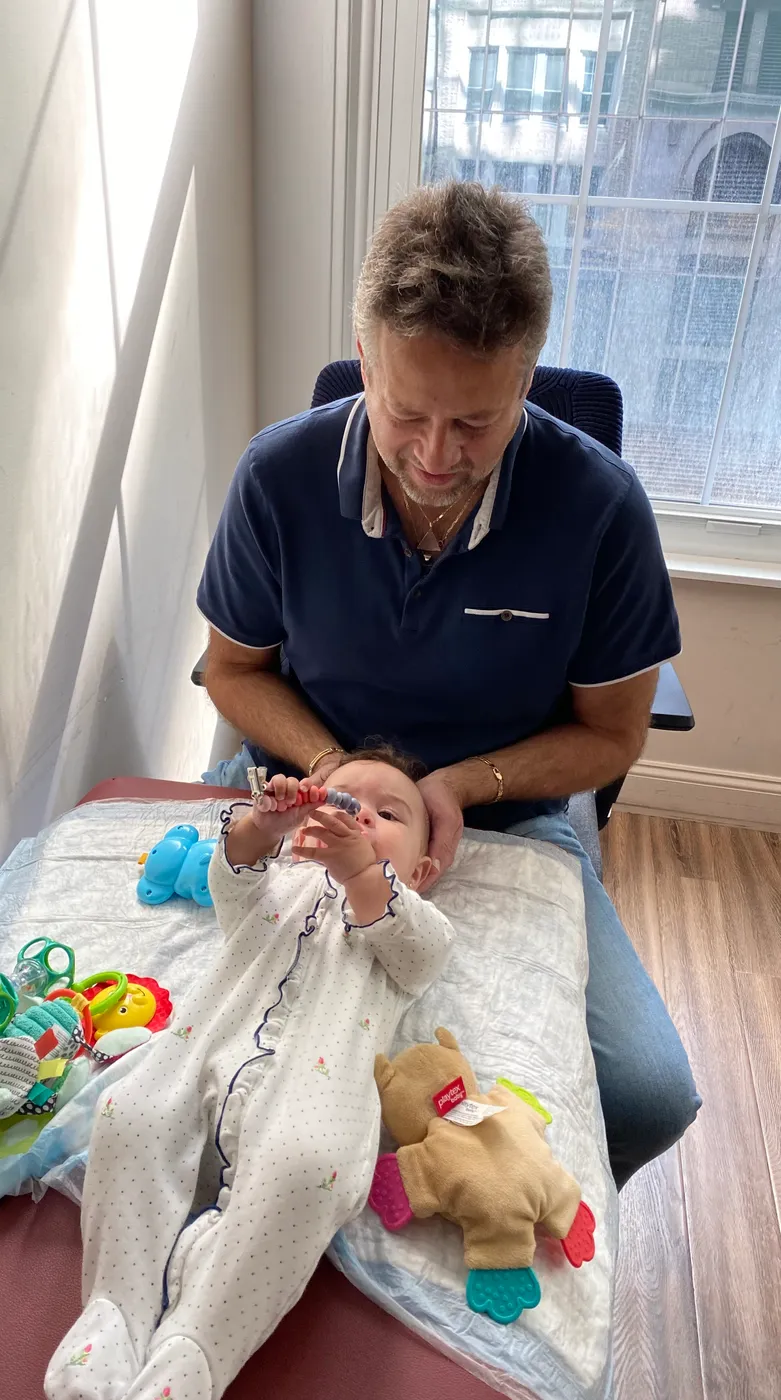
Plagiocephaly, often called flat head syndrome, occurs when a baby's skull develops a flat spot or asymmetry. Like most conditions, it has a spectrum of severity: some babies have mild plagiocephaly, while others can have more pronounced cranial distortions.
The condition can occur for congenital reasons (present at birth) or develop throughout infancy from positional or deformational causes. Babies spend a great deal of time on their backs — on the order of 700 hours — not including time in baby containers such as car seats and strollers. Statistically, more than half of babies experience one of the two forms of plagiocephaly, either congenital or positional, to some measure.
No two babies are alike, and that includes head shape. Head shapes vary depending on how a baby is born and the positions they spend time in during their first few months of life. A baby's skull is softer at birth so that it can shift and move through the birthing process as needed, and most babies' heads return to a round shape shortly after birth. As babies get older, a flat spot may begin to develop on the back or side of the head. Because young babies cannot yet move around or sit up, lying in one position for long stretches can create this flat spot on the skull.
Plagiocephaly typically becomes a concern only when there are gross asymmetries in a child's head. Early, gentle assessment helps clarify what is happening and guide supportive next steps.
Along with a flat area on the skull, head shape changes are often accompanied by some degree of facial asymmetry. Parents may notice one or more of the following as they observe their baby day to day.
Several factors can contribute to flat head syndrome. Some are present from birth, while others build up gradually as a baby spends time resting and feeding in the same position.
Every case is unique, and an evaluation helps guide the most appropriate next steps for your baby.
Plagiocephaly is associated in the research with effects on brain function — one citation notes it can contribute to an under-functioning of the central nervous system and, in turn, decreased performance throughout the body. Head shape and facial asymmetry have many possible causes, so always have your pediatrician evaluate your baby. Seek prompt medical care for warning signs such as a bulging or sunken soft spot, fever, persistent vomiting, unusual irritability, or any developmental concern. Craniosacral therapy is complementary and does not replace medical diagnosis or treatment.
Understanding how to support a baby's head shape starts with understanding the cranium. The skull's fontanels — its soft spots — naturally solidify and come together over the first months of life on a fairly predictable timeline.
Because the skull is still developing during this period, gentle, well-timed support can help guide natural growth while these windows are open.
Craniosacral therapy and chiropractic care are gentle, non-invasive options that can support balance in the cranial and spinal system. For plagiocephaly, the goal is to ease restrictions and give the head a chance to realign as your baby grows.
These treatments assess your baby's spine and cranial dural system, looking for any imbalances that may be present. Craniosacral therapy and chiropractic care for babies are extremely gentle: they involve very small adjustments using light finger pressure — no more than you would use to check the ripeness of a fruit.
A subluxation occurs when one or more of the bones of the skull and spine (the vertebrae) move out of position and create pressure on, or irritate, spinal nerves. Between each of the bones in the spine are spinal nerves; pressure or irritation on those nerves can cause malfunction and interfere with the signals traveling over them. When a vertebra subluxates, there is decreased motion in that joint, which reduces a baby's range of motion.
When a vertebra in the cervical spine subluxates, the entire neck and head are affected. If a baby cannot move the neck freely because of a restriction, the baby will tend to keep the head in one position for extended periods — which can contribute to plagiocephaly. By gently addressing restrictions in the head and spine through specific craniosacral therapy and, where appropriate, chiropractic adjustments, the baby's head is given a chance to realign and the flattening has an opportunity to diminish.
If you have concerns about your baby's head shape or neck movement, or you would simply like an evaluation, please reach out to the office. You can also learn more about our pediatric craniosacral therapy and how it relates to torticollis.
Craniosacral therapy and chiropractic care are gentle, complementary approaches offered alongside your child's medical care. Results vary from baby to baby, and these methods do not cure conditions, guarantee outcomes, or replace diagnosis or treatment from your pediatrician.
Plagiocephaly, often called flat head syndrome, is a flat spot or asymmetry in a baby's skull. It can be congenital (present at birth) or positional, developing during infancy from prolonged time in one position. It ranges from mild to more pronounced cranial distortion.
Craniosacral therapy and chiropractic care for babies are extremely gentle. They involve very small adjustments using light finger pressure, no more than you would use to check the ripeness of a fruit. The work is non-invasive and complementary to your pediatrician's care.
Restriction in the cervical spine can reduce a baby's neck range of motion. If a baby cannot turn the neck freely, the head tends to rest in one position for long stretches, which can contribute to flattening. Easing those restrictions gives the head a chance to realign.
The fontanels solidify over the first months of life. The posterior fontanel closes around 1 to 3 months, the sphenoidal and mastoid fontanels around 6 months, and the anterior fontanel around 12 to 18 months. Early support can help guide natural growth during these windows.
Always have your pediatrician evaluate any concern about head shape, facial asymmetry, or neck movement, and seek prompt medical care for warning signs such as a bulging or sunken soft spot, fever, vomiting, unusual irritability, or developmental concerns. Craniosacral therapy supports medical care; it does not replace diagnosis or treatment.
Call the office or send a request and the practice will follow up about availability, your questions, and a gentle plan for your baby. Care is offered alongside your pediatrician.